
Vterra is a self-contained platform that serves leaders and organizations that have previously have been left out of the advisory game.
Uniquely, Vterra does not begin with AI. It begins by establishing shared direction. This sequencing is deliberate and reflects a considered position on why most AI deployments underdeliver.
1. Establish the value creation framework
2. Load the organizational context
3. Let AI reason from that foundation
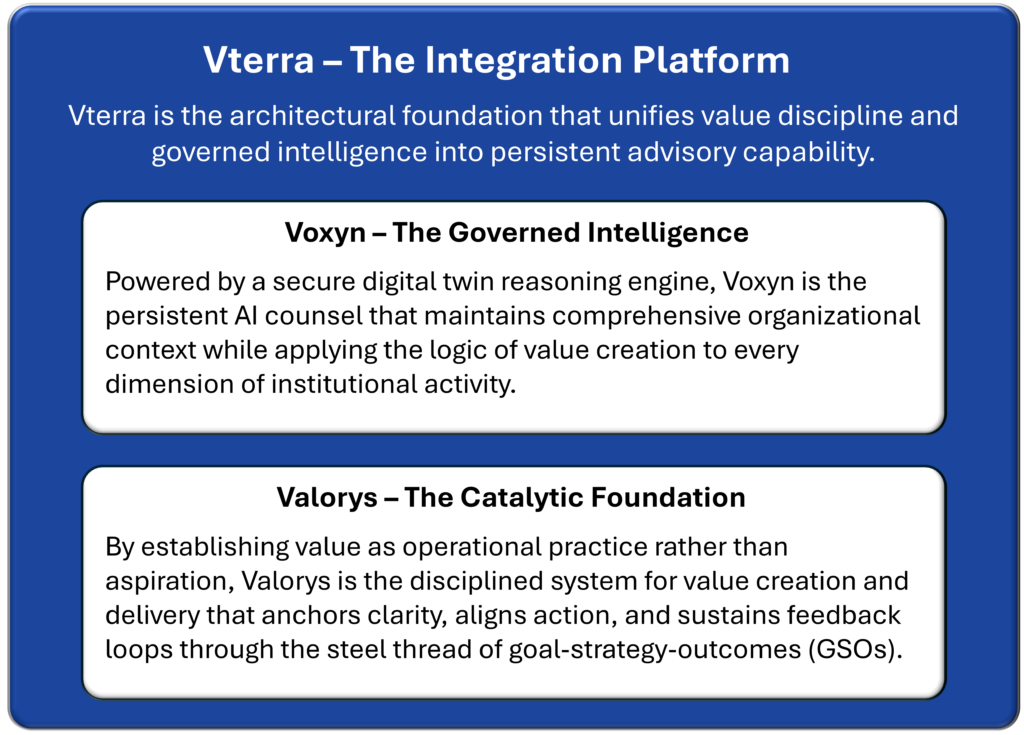
The Vterra architecture ensures that AI serves your organization in a consistent, governable manner.
BCG’s 2024 analysis found that while 72% of organizations have adopted some form of AI and global investment exceeds $560 billion, 74% have yet to demonstrate tangible value from that investment. The problem is not the technology. The problem is that organizations are deploying AI into a context that lacks the interpretive structure needed to make its outputs meaningful and actionable.
Vterra inverts that sequence. Valorys establishes what the organization exists to create and deliver—the interpretive filter through which every piece of organizational data receives meaning. Voxyn then draws from that context to produce advisory responses grounded in institutional reality rather than abstracted from it. Neither component is optional. Removing either one returns the system to the condition it was built to correct.
Within Voxyn is the digital twin—the organizational knowledge repository that Voxyn’s reasoning engine draws from when considering a specific challenge. Most tools give leaders more data. The digital twin gives the reasoning engine something more valuable: context—the institutional memory, purpose, and operational history that transforms data into meaningful guidance. Data is important, but without context it is insufficient. This is where the platform becomes genuinely differentiated from any general-purpose AI tool.
That differentiation is architectural. Unlike a traditional relational database that stores and retrieves raw data, Voxyn’s reasoning engine operates on a vector database—one that stores information as embeddings, high-dimensional numerical representations that encode the semantic meaning of text, images, and other content. When a leader brings a question to Voxyn, the engine is not matching keywords or retrieving records. It is measuring the conceptual distance between the question and everything the organization knows about itself—returning guidance that is contextually closest to the leader’s actual situation, even if they share no keywords in common.
The response is therefore not generated from the internet or aggregate training data. It is reasoned from the organization’s own context: its financials, its strategic priorities, its compliance environment, its historical decisions, its competitive landscape—all populated by the organization itself, behind its own firewall, on infrastructure it controls entirely.
This approach has two consequences. First, the advice is contextually grounded in a way no external advisory tool can replicate. Second, the institutional knowledge that accumulates inside the digital twin becomes a compounding organizational asset—one that grows more precise over time and never walks out the door when people leave.
The digital twin ensures the advice becomes more precise as the context becomes richer.
The platform is open source not as a cost strategy, but as a structural commitment. No vendor controls the roadmap. No company can change the terms. Your organization owns its deployment entirely—behind your own firewall, on your own infrastructure, with a model you control. The digital twin belongs to you. Released under the Apache License 2.0: yours to use, adapt, and extend without condition.